Network Infrastructure Teams Manage Peak Loads During Clustered Premier League Fixtures
Written by Lars Schröder · Oct 21, 2026
Network Infrastructure Teams Manage Peak Loads During Clustered Premier League Fixtures
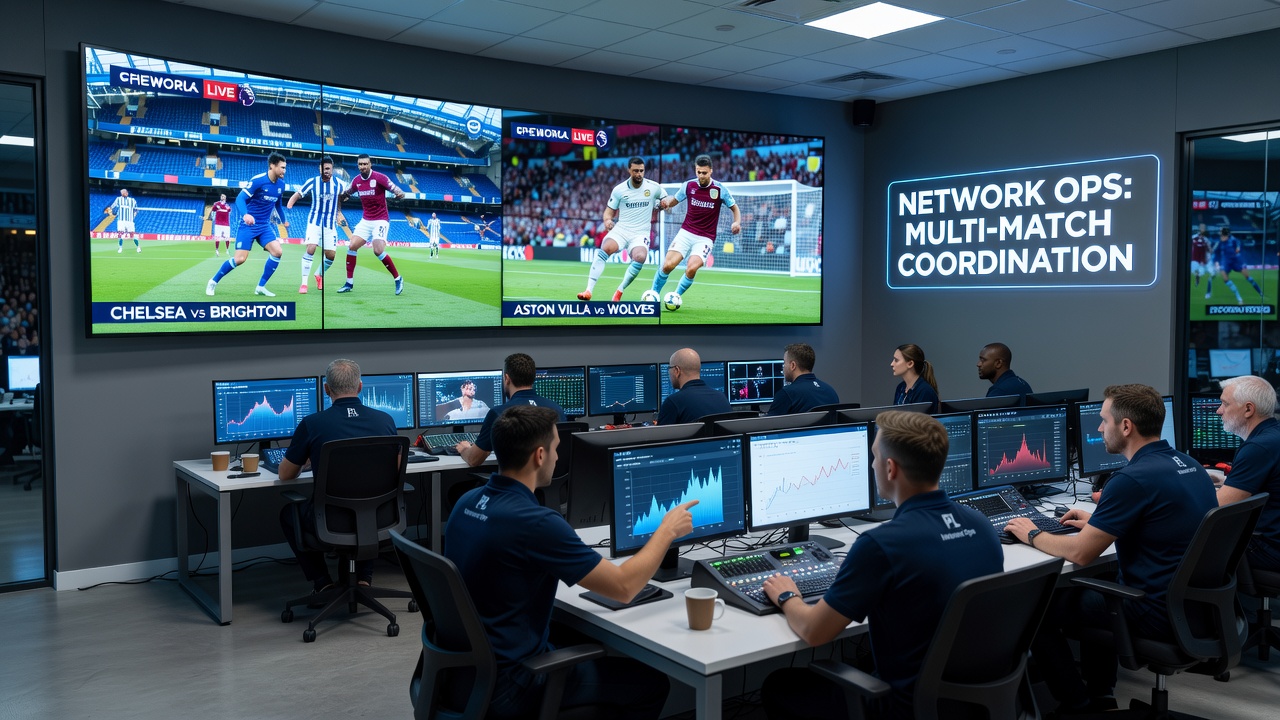
Network infrastructure teams coordinate bandwidth allocation and server scaling when several Premier League matches occur on the same afternoon, and fixtures such as Chelsea against Brighton together with Aston Villa versus Wolves create overlapping viewer peaks that test distribution systems across fixed and mobile networks. These events generate synchronized traffic spikes as audiences access live streams through apps, smart TVs, and set-top boxes, while operators route data through regional points of presence to maintain consistent delivery.
Traffic Patterns During Double Headers
Data from past seasons shows that concurrent matches increase aggregate bandwidth consumption by 35 to 50 percent compared with single-game slots, because viewers often switch between feeds or watch one match while monitoring another via multi-view interfaces. In October 2026 the calendar includes several such afternoon clusters, and planners already model expected loads using historical telemetry from similar weekends. Operators activate additional cache nodes in London, Manchester, and Birmingham to absorb the extra requests without latency spikes.
Content delivery networks adjust routing tables in real time so that streams for both matches travel over diverse paths, and any single link failure does not interrupt service for either fixture. Teams monitor quality-of-service metrics such as packet loss, jitter, and round-trip time, then shift traffic to underutilized segments when thresholds are crossed. This dynamic balancing occurs through automated scripts that respond within seconds, while human supervisors review dashboards for anomalies that automation might miss.
Coordination Across Multiple Venues
Stadiums equipped with dedicated fiber uplinks feed raw footage to broadcast centers, where encoders compress 4K and HDR signals into adaptive bitrate ladders that range from 720p at 3 Mbps up to 1080p at 8 Mbps for most households. When two matches run simultaneously, encoding farms must allocate GPU and CPU resources in parallel, and any delay in one pipeline can cascade if teams do not synchronize buffer management. Engineers therefore share a common incident channel that logs encoder health, CDN fill rates, and origin server response times for both events.
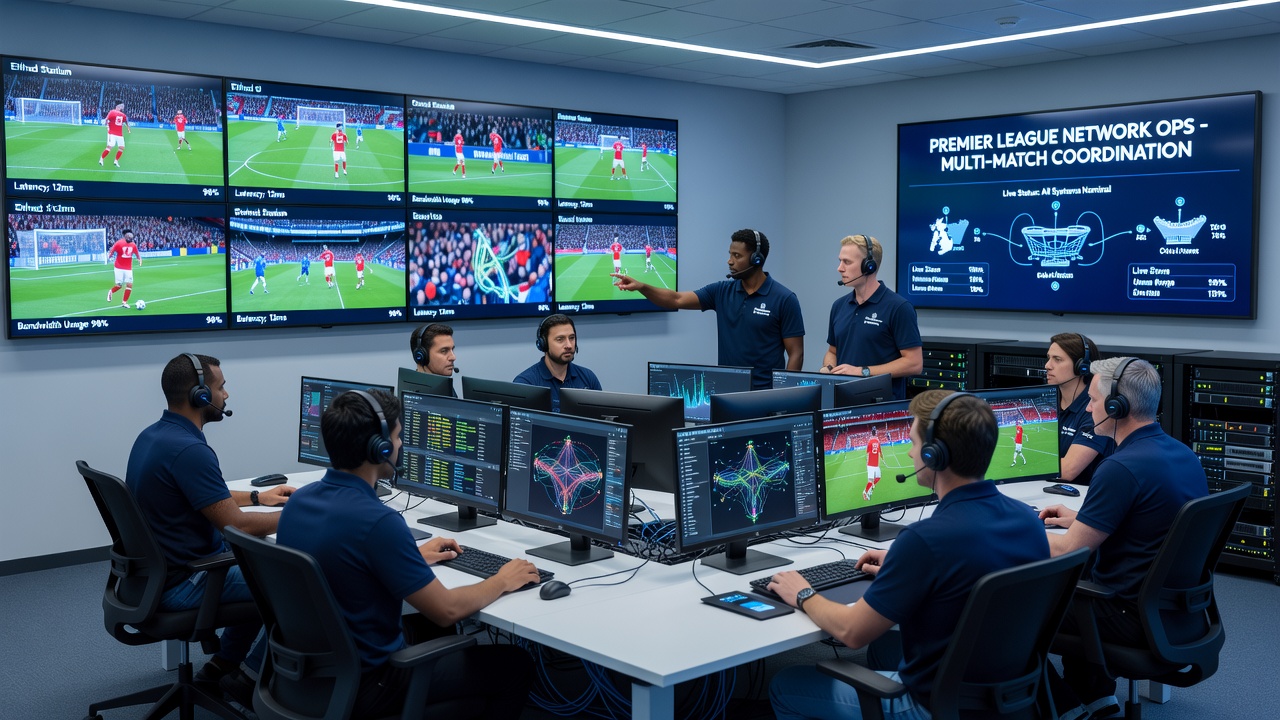
According to figures released by the European Telecommunications Standards Institute, live sports traffic accounts for more than 60 percent of peak evening bandwidth in several European countries during the football season. Mobile operators in the UK report that 5G small cells near pubs and fan zones carry the majority of secondary-device viewing, and they pre-provision extra spectrum during double-header weekends to prevent congestion. Researchers at the University of Bristol documented similar patterns in a 2024 study of concurrent live events, noting that predictive scaling reduced rebuffering events by 22 percent.
Regional and International Distribution
International feeds travel through satellite uplinks and undersea cables to rights holders in Asia, North America, and Australia, and each region applies its own subtitle and commentary tracks that add marginal overhead to the primary video stream. Network teams therefore coordinate with overseas partners to confirm that transatlantic routes remain clear during the critical 90-minute windows. When Aston Villa versus Wolves coincides with Chelsea against Brighton, the combined viewer base can exceed 10 million concurrent connections worldwide, according to industry estimates compiled by the Global System for Mobile Communications Association.
Security layers inspect traffic for distributed-denial-of-service attempts that sometimes target high-profile fixtures, and operators deploy rate-limiting rules that activate automatically when traffic signatures match known attack patterns. These measures run alongside normal load-balancing operations, so coordination meetings between security and delivery teams occur daily in the week leading up to clustered match days.
Conclusion
Network infrastructure teams rely on layered monitoring, pre-positioned cache capacity, and cross-team communication protocols to keep streams stable when multiple Premier League matches unfold together. The approach has evolved through successive seasons as data volumes grow and viewer expectations for uninterrupted playback remain high. Continued investment in automated orchestration tools and expanded peering agreements supports these requirements without interruption.